1FDE Mindset, Customer Discovery and Problem Framing. An FDE does not start with AI. An FDE starts with the customer's work, measures it, and only then decides what to build.3 labs
2Solution Architecture, System Design and Technical Scoping. Before you write the bot, you size it, decide each big choice on paper with reasons, and plan what happens when a part is slow, costly or down.3 labs
3Python Like a Software Engineer. Code that works once is a script; code that others can read, install, test and change safely is software, and an FDE must hand over software.3 labs
4Git and GitHub Hands-On. Git is a time machine for your project that also lets a whole team change the same files without overwriting each other.3 labs
5Data for FDEs: SQL, APIs and System Integration. Most client data lives in databases and APIs, and an FDE's job is to read it correctly, check it, keep its trail, and never let a query or a model damage it.3 labs
6FastAPI: Build and Test a Real API. An API is a promise to other programs about which addresses exist, what data they accept and what answers they give, and FastAPI lets you write that promise in Python and test it.3 labs
7Cloud, Containers, CI/CD and Infrastructure as Code. Package the app once, so it runs the same everywhere, and put an automatic pipeline with safety gates between your laptop and production.3 labs
8LLM APIs and Prompt Engineering. A model API is a function that takes a list of messages and returns text; prompt engineering is writing that list so the answer is right, safe, cheap and in the shape your code needs.3 labs
9LLM Apps with LangChain. LangChain gives every part of an LLM app (prompt, model, parser, memory) the same shape, so you can snap them together like pipes and swap any part without rewriting the rest.3 labs
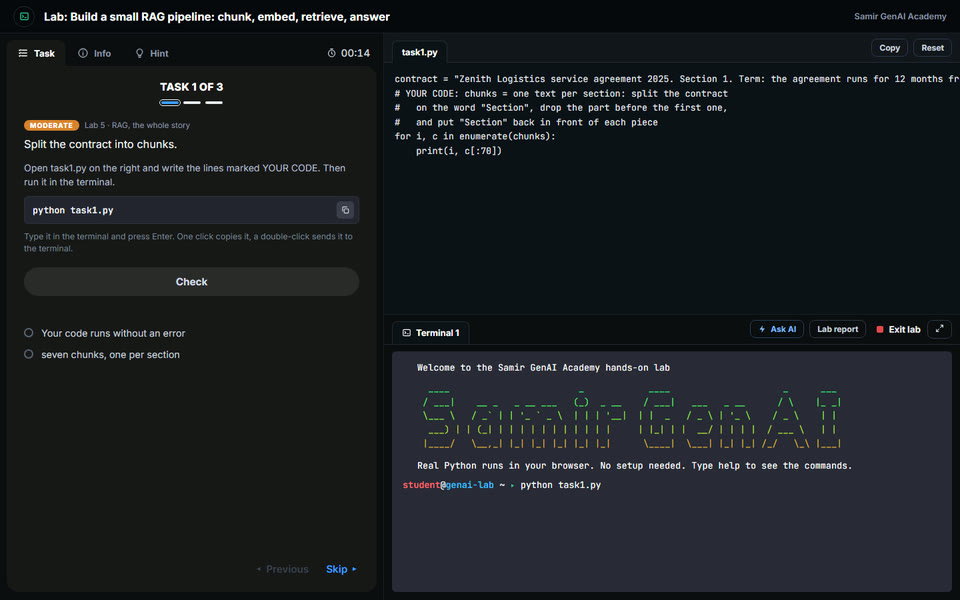
10RAG: semantic search, text to SQL, hybrid and citations. RAG means: first find the right evidence (in documents or in tables), then let the model answer only from that evidence and show where it came from.3 labs
11Tools, Agents and LangGraph Workflows. A model can only talk; tools let it act, and a workflow decides how much freedom it gets to act.3 labs
12MCP: Build a Server and Client with FastMCP. MCP is a standard plug, so any AI app can find and use your tools, data and prompts without custom glue code for each app.3 labs
13Evaluation: golden sets, LLM-as-judge and release gates. You cannot safely change an AI system you do not measure, so build a fixed test paper, mark every version on it, and let written rules decide what ships.3 labs
14AI safety, security and governance. An AI system is safe only when the rules that matter (who you are, what you may see, what you may do, what may leave) are enforced in code around the model, tested by attacking it, and recorded so someone can be held accountable.3 labs
15Deploy and Operate AI with FastAPI. A model becomes a product only when it runs as a reliable, secure, observable API: loaded once, guarded at the door, honest about its health, fast when things around it are slow, and measured against a promise.3 labs
16Customer Delivery and Communication: Charts, Data Story, ROI and Handover. An AI system is only delivered when the customer understands what it did, trusts the numbers, decides what to do next, and can run it without you.3 labs
CEnterprise Capstone: Build, Break, Deploy and Defend an AI Dispatch Copilot. An enterprise capstone is one real client problem solved end to end: messy data in, safe and cited decisions out, deployed, broken on purpose, fixed, and explained to the people who pay for it.3 labs
DSAOptional: Data Structures and Algorithms for Product-Company Interviews. A data structure is the shape you give your data, and an algorithm is the way you walk through it; the right pair turns an answer that takes an hour into one that takes a blink.optional